Back to projects

Butterfold
How might we help people suffering from alcohol abuse disorder and social anxiety achieve their sobriety goal?
The problem
Alcohol abuse disorder causes detrimental health and social consequences for the drinker, the people around the drinker, and society at large, as well as the patterns of drinking that are associated with increased risk of adverse health outcomes. While the effectiveness of the employment of group therapies has been largely demonstrated, this also constitutes a strong limitation for all those subjects who suffer from social anxiety.
Furthermore, in the last few years, there’s been a growing interest and preference toward the self-management and self-monitoring of mental health through a smartphone.
Alcohol abuse disorder causes detrimental health and social consequences for the drinker, the people around the drinker, and society at large, as well as the patterns of drinking that are associated with increased risk of adverse health outcomes. While the effectiveness of the employment of group therapies has been largely demonstrated, this also constitutes a strong limitation for all those subjects who suffer from social anxiety.
Furthermore, in the last few years, there’s been a growing interest and preference toward the self-management and self-monitoring of mental health through a smartphone.
The solution
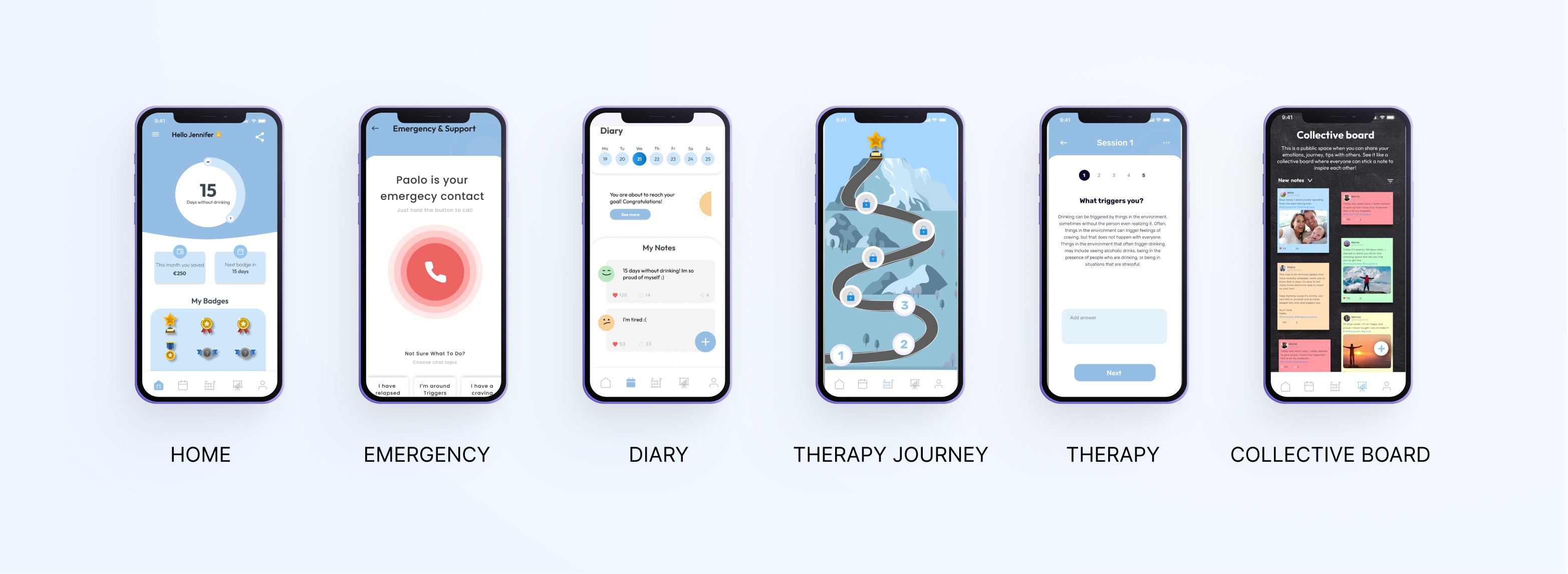
A mobile app focused on gamified cognitive behavioral therapy that addresses anxiety and low mood, without losing the (virtual) social component that is key to the therapy's success.
The solution
A mobile app that allows following a gamified cognitive behavioral therapy, that addresses anxiety and low mood, without losing the (virtual) social component that is key to the therapy's success.
The process
Understand
Understand
Understand
In order to find out and discover the scope of the issues we conducted secondary research on alcohol abuse disorder, its connection to social anxiety and mobile apps.
Over half of the population in the United States owns a smartphone and 83% of these users do not leave their homes without it. [1]
The demand for MHapps is strong, as evidenced by a recent public survey that found that 76% of 525 respondents would be interested in using their mobile phones for self-management and self-monitoring of mental health if the service were free. [2]
Individuals with social anxiety have difficulty participating in group settings. Although it makes intuitive sense that social anxiety could present a challenge in an addiction treatment setting, which often involves small groups and encouraged to participate in self-help groups like Alcoholics Anonymous. Social anxiety and alcohol addiction are especially common co-occurring conditions.
Cognitive behavioral therapy (CBT) for substance use disorders has demonstrated efficacy as both a monotherapy and as part of combination treatment strategies.
In order to find out and discover the scope of the issues we conducted secondary research on alcohol abuse disorder, its connection to social anxiety and mobile apps.
Over half of the population in the United States owns a smartphone and 83% of these users do not leave their homes without it. [1]
The demand for MHapps is strong, as evidenced by a recent public survey that found that 76% of 525 respondents would be interested in using their mobile phones for self-management and self-monitoring of mental health if the service were free. [2]
Individuals with social anxiety have difficulty participating in group settings. Although it makes intuitive sense that social anxiety could present a challenge in an addiction treatment setting, which often involves small groups and encouraged to participate in self-help groups like Alcoholics Anonymous. Social anxiety and alcohol addiction are especially common co-occurring conditions.
Cognitive behavioral therapy (CBT) for substance use disorders has demonstrated efficacy as both a monotherapy and as part of combination treatment strategies.
Identify
Identify
Identify
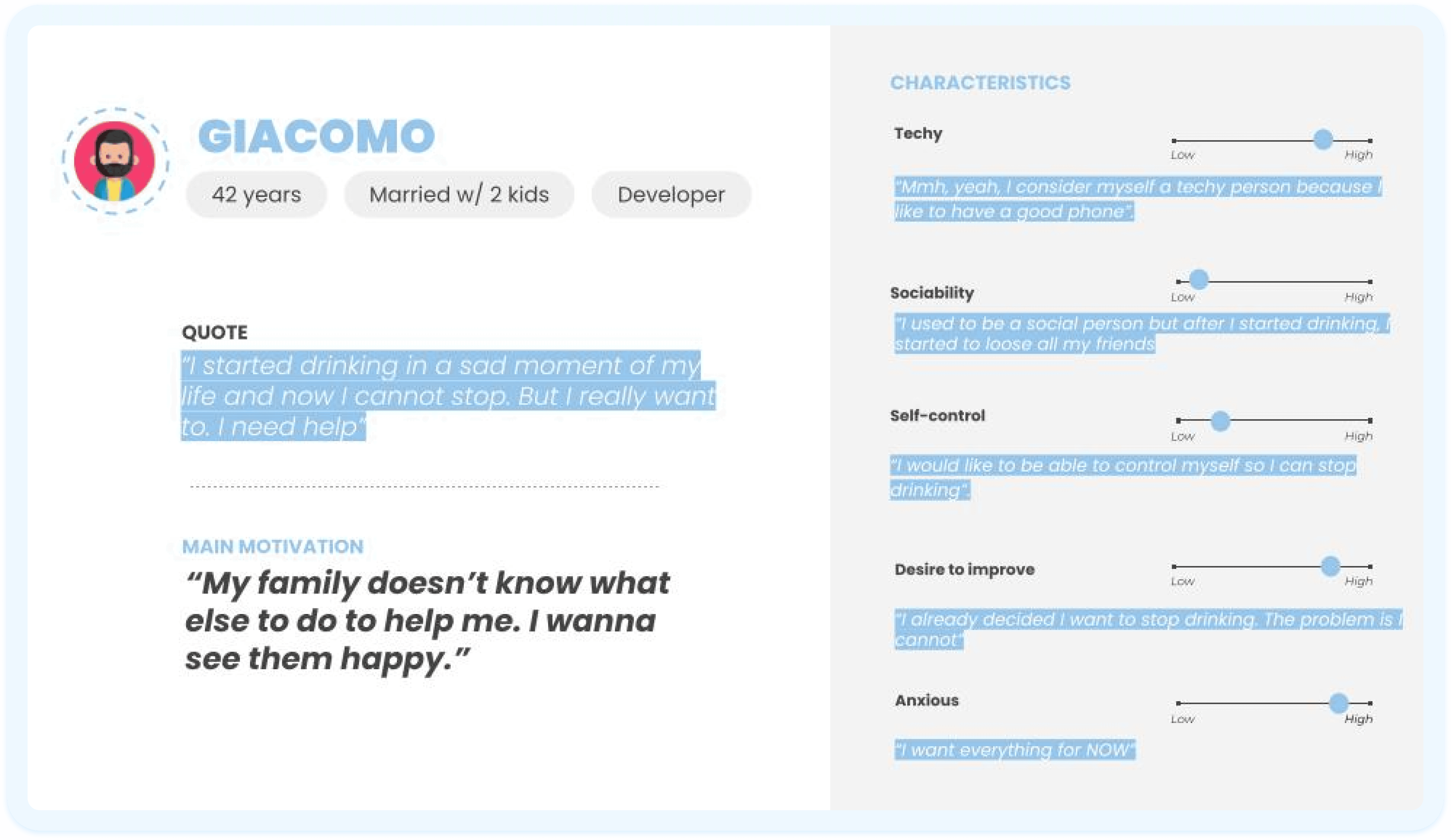
Based on the insights gathered from desk research, we developed personas to represent key user groups and their needs.
We then conducted the competitive audit of similar apps, like “Sober Today” and “I am Sober”. We took in consideration different factors such as functionalities, features, gamification, support in case of relapses.
Based on the insights gathered from desk research, we developed personas to represent key user groups and their needs.
We then conducted the competitive audit of similar apps, like “Sober Today” and “I am Sober”. We took in consideration different factors such as functionalities, features, gamification, support in case of relapses.
Ideate & Prototype
Ideate & Prototype
Ideate & Prototype
Paper prototyping was the best tool to think through and validate our initial ideas. We started sketching by hand the screens which then got refined in the following stages of the process. This allowed us to quickly validate the single design choices. We later realized high fidelity wireframes.
Paper prototyping was the best tool to think through and validate our initial ideas. We started sketching by hand the screens which then got refined in the following stages of the process. This allowed us to quickly validate the single design choices. We later realized high fidelity wireframes.
Test
Test
Test
We then conducted usability studies on the wireframes to evaluate the effectiveness of the proposed solutions. The key performance indicators included time to complete tasks, error rate, and drop-off rate, allowing us to identify usability issues and areas for improvement.
We then conducted usability studies on the wireframes to evaluate the effectiveness of the proposed solutions. The key performance indicators included time to complete tasks, error rate, and drop-off rate, allowing us to identify usability issues and areas for improvement.
The final product

Back to projects